| Product | Weiss DAC204 |
| Type | USB Digital-to-Analogue Converter (DAC) & Headphone Amplifier |
| Category | Digital |
| Key Technologies | Professional-grade digital conversion, USB audio interface, precision clocking, balanced analogue output and integrated headphone amplifier |
| Recommended For | Audiophiles seeking studio-quality digital playback with outstanding accuracy, refinement and compact design |
| Verdict | An exceptionally transparent and musically engaging DAC offering reference-level performance, premium engineering and excellent long-term value. |
| Tannoyista Rating | ★★★★☆ (4.5 / 5) |
Reviewed by Josie Willow-Hecate Lewis for Tannoyista • 24 June 2024
Independent editorial review based on real-world listening evaluation.

The Weiss DAC-204 is one of the best DACs on the market. It's sound is second to none whilst it's versitility is truly remarkable.
T here’s something about the sound of a DAC that can either switch you on or off. The Weiss DAC-204 is here at Tannoyista and it’s re-writing my experience in digital audio performance.
Back in the 90s, I worked in a recording studio, and there was gear that was used occasionally and not so impressive, and there was gear that was used and cherished on every recording.
Back then, the shift from analogue recording to digital recording was on the rise, and although both were used, there were some pieces of kit that were always used: the Weiss EQ-1 and the wonderful DS-1 mastering unit.
Just about every major studio had one or both units, and they weren’t cheap. Practically every album back then and many since still use these units and are still very highly regarded. This was my first encounter with Weiss.
So, after all those years, I’m very proud to review the Weiss DAC-204, something that is obviously much less of a studio workhorse but brings both professional robust build and performance to our more sedate world of Hi-Fi.
Over the years, I’ve tried some very fine vintage and modern DACs, from the olde TD1541A type to the more modern ones like the Allo Katana, Revolution, Denafrips Aries II, Topping D-10, DX-9, and a brief time with a Chord Dave.
The Chord Dave was the most impressive, in my opinion, and the Allo Revolution was also very good. I won’t go into specifics with the others, but all had their positive and not-so-positive points; some left me cold in different areas and didn’t impress me at all. But in general, I enjoyed most of them in different ways, and comparisons between them were academic, as each performed within their respective price range.
So, will the Weiss be something different? Something to bring everything I’m looking for together in one unit?
Read on.Unboxing the Weiss DAC-204:
The DAC-204 comes well packed in a tissue-wrapped box, which is a nice touch. And inside the box is a QR-coded manual leaflet.

The first thing you notice when unwrapping the DAC is it’s size and weight. It’s a nice weight—not too heavy but enough to signify a quality build. It's weight also prevents it from rearing up once cables are attached in the back. The DAC is compact and nicely sized, which is a good fit for busy Hi-Fi racks.
The power supply is a medical-grade in-line block type, which is quite adequate. Although there is a matching power supply from Weiss, the PSU102, which I would simply love to review at a later date,. For me, music starts at the plug socket.
A closer look and connections of the DAC-204:
F
rom my perspective on today's design trends, I've always liked the simple nature of equipment. It has to be clean and functional. Most of the pro gear I used was easy to control and easy to understand, and this, like other Weiss equipment, is how the DAC-204 is designed.
The unit is elegant and free of complications. An understated design that will never be out of fashion. Simple toggle switches set the look together with simple LED lights. The sides have a nice, smooth black finish.

Connections:
The DAC-204 doesn’t include the DSP functions, headphone preamp, or screen display of the 501; In contrast to the DAC 205, the DAC 204 has an INT 204 board built in. Which means it is a digital Interface as well. USB -> S/PDIF with a DSD to PCM conversion feature.
The INT-204 is also available as a separate, standalone unit.
Starting at the business end, the back connection panel. It’s probably the best layout of such a compact unit I’ve seen. Everything is well spaced out, labelled, and easy to get to.
All of the connections are top quality, from excellent RCA connections to gold-plated XLR sockets.

Here is Daniel to explain more:
Digital inputs:
| USB Input | 1 × USB Type-B |
| Coaxial S/PDIF Input | 1 × Gold-plated RCA |
| Optical Input | 1 × Toslink (Optical S/PDIF) |
| USB Supported Formats | PCM: 44.1, 48, 88.2, 96, 176.4, 192, 352.8 & 384 kHz DSD64 & DSD128 |
| RCA S/PDIF Supported Formats | 44.1, 48, 88.2, 96, 176.4 & 192 kHz |
| Toslink Supported Formats | 44.1, 48, 88.2 & 96 kHz |
| Analogue Outputs | Stereo gold-plated RCA and balanced gold-plated XLR outputs |
| Digital Outputs |
1 × AES/EBU (gold-plated XLR) 1 × Gold-plated RCA S/PDIF 1 × BNC S/PDIF |
| Power Input | External power supply input |
| Output Gain Control | Rear-panel attenuation switches providing four selectable output levels to better match system gain. |
| Gain Settings |
State 1: 0 dB (both switches open) State 2: −10 dB State 3: −20 dB State 4: −30 dB (−10 dB + −20 dB, both switches engaged) |

The front panel of the DAC:
The front panel has a series of toggle switches controlling inputs and conversion rates, as well as indicator lights.
| Power | 1 × Power on/off toggle switch |
| Input Selector |
State 1: USB State 2: Toslink (Optical) State 3: RCA S/PDIF |
| DSD Conversion | Dedicated toggle switch for DSD conversion mode |
| PCM Sample Rate |
State 1: 176.4 kHz State 2: 88.2 kHz |
| Word Length |
State 1: 16-bit State 2: 24-bit |
| Status Indicators | LED indicators display the selected input and active conversion settings. |

More about the DAC-204:
My preferred digital music format is CD, as I have lots of them, and occasionally, SACD, but, alas, my SACD player gave up the ghost, so my older Bluray player was dug out and put to work for this review.
My CD player is a Denon DN-961FA. This is a professional broadcast CD player that has an AES/EBU output. It’s a vintage machine from around the late 90s and early 2000s.
I’ve been using the Denon as a transport for quite some time, and although it’s 25+ years old, it’s proven to be a very solid, reliable, and stable unit.
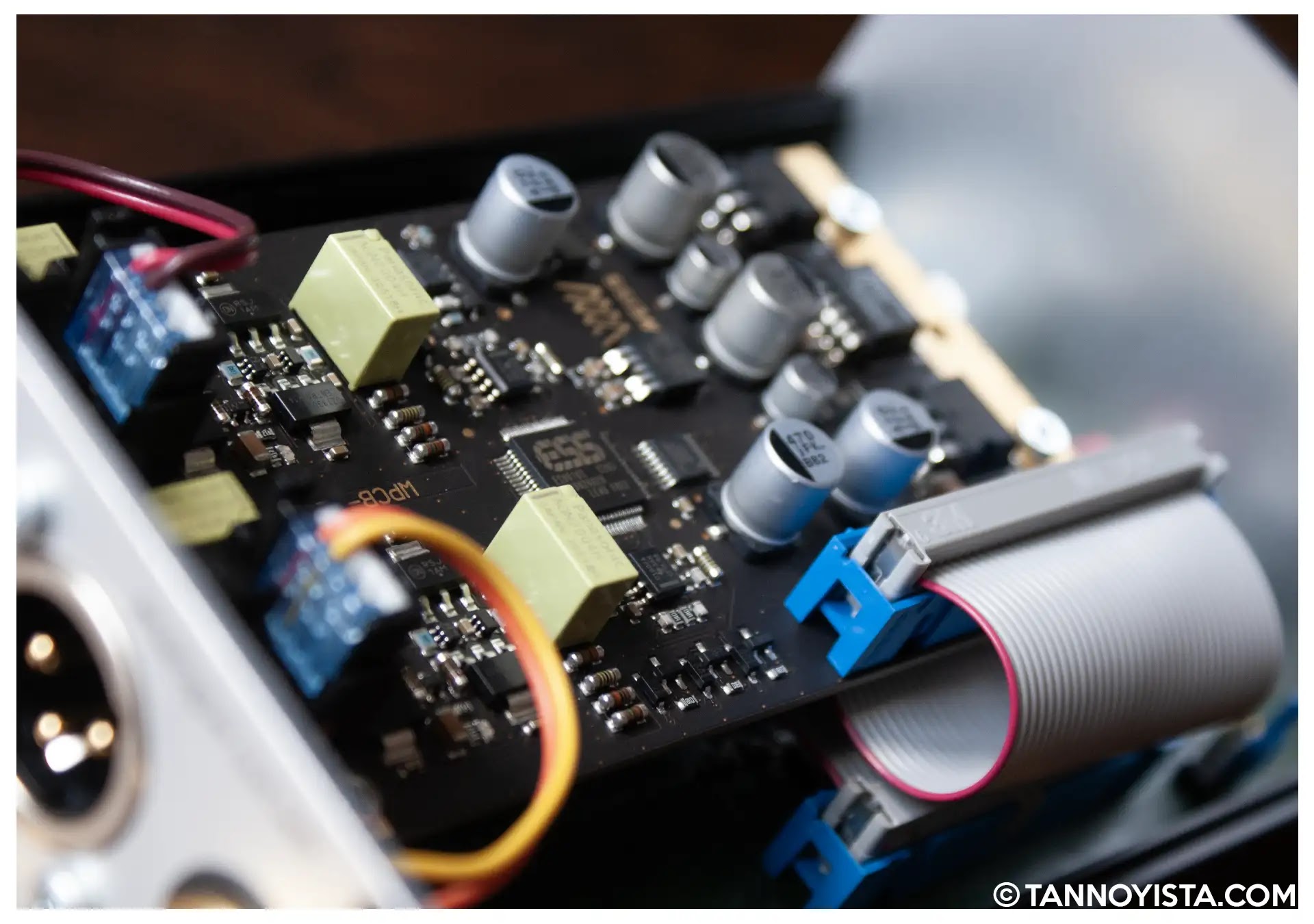
The Weiss DAC-204 brings things a whole lot further. Utilising the single ESS 9018S, it uses four oversampling Sigma-Delta D/A converters per channel. Now, I know that the 9018S has been around for some time, but take the TDA1541A for example. I’ve been stunned at what that chip can do, more so than many modern D/As. I really liked the sound of the TDA1541A, but only when it was done right.
And this is where Daniel Weiss comes in to his own. Any DAC can be dressed up in as much fancy clothing as you want, but when you buy a DAC, you want it to be designed by someone who knows their onions, like Daniel; it becomes a work of audio art, if you like.
From my experience, it’s about the design and the know-how in how it’s implemented that matter.

The Weiss DAC-204 is very versatile, and Weiss themselves have given it the sobriqet of a ‘Swiss Army Knife’ which I find very fitting. It can convert normal CD 44.1 kHz signals as well as the higher-resolution DSD to PCM. Not only that, but you can use it as a pass-through to another DAC or preamp while simultaneously using it’s own DAC.
This is also a great feature if you want to convert USB audio directly to AES.
The great thing is that you can connect multiple digital sources to the DAC and simply flick a switch to swap between them.

Connecting the Weiss DAC-204:
In my system, I use both single-ended (RCA) and balanced (XLR) connections, but I use balanced the most. So, this DAC works well with my setup.
For standard CD redbook purposes, I’m using a 110-ohm connection from the AES output of my CD player to the RCA connection on the DAC-204. It was time to spin some CDs. For SACD/DVDA, I’m using optical.
For USB audio, I’m using Foobar, and I’ll be using normal redbook files and DSD files such as DSF.
For the audio output, I’ll be using both balanced and unbalanced connections.

What does the DAC-204 sound like?:
Once connected, my first thing was to check for any operation noise, and I found the DAC to be totally silent, which is a good start. I then left the DAC running for around an hour without a signal.
I find that with anything brand new, it needs a bit of time to get up to temperature. In this case, it felt like it was the longest hour ever, as I was very excited about this DAC.
Using a CD Transport
Flicking the input switch to RCA, I cued up a CD and pressed play.
The first CD I played was a copy of The Chemical Brothers - We Are the Night. The first track starts up slowly, with lots of details flying around the sound stage. And what a nice surprise! The sound stage seemed vast, wide, and deep. A few tracks in, it was evident that the 204 was starting to get it’s mojo workin’.
Firstly, the bass. While I was used to the vinyl version of this album, the CD version with some other DACs could sound a little bit lifeless. The Weiss changed all that. I found myself standing up, a little perplexed. It sounded smoother, rounder, and more tape- or vinyl-like. With the bigger, more vast soundstage, everything clicked.
In my eagerness to see what else the Weiss could bring, I wanted to try something more rock-based. Van Halen, 0U812, was popped in, and, wollop! Yeah! This is what I was hoping for. From the first vocal intro from Sammy Hagar, followed by drums and guitar, I had to smile a BIG smile.
And that, my friends, is what I was hoping for. The separation of the vocals and the instruments was astonishing. The snap of the drums and guitars flew with energy. It was almost like someone had pulled the walls further apart—a great stage. Although it was recorded in 1987/88, it could still kick ass.
After a few more discs, I found myself enthusiastically digging out stuff I hadn’t played in years. Very enjoyable indeed.

Using USB and Optical inputs
Moving on from the classic redbook format, it was time to give USB audio a try, along with a few SACDs.
I use Foobar and my laptop, and although setting it up took a bit of time, I got it working with no real drama. One thing you do need to do is download the XMOS USB Audio driver before anything else. This is available from the Weiss website.
First of all, I tried some normal 44.1 kHz files. These sounded the same as on my CD player with maybe a little more definition. Then I tried some DSF files. On the front of the DAC are two conversion toggle switches, which Weiss recommends for 176.4 / 24 bit. But for this first case, I started with 88.2 / 16 bit, just for giggles. So I started with Queen, A Night at the Opera.
I know this recording very well indeed, and as it started, I instantly felt that as the music started to grow, it had a nicer, smoother, and more weightier sound than I had previously found via my SACD player which was surprising. As I went on, I couldn’t fault the sound whatsoever. Everything was nicely placed, and again, the sound stage was nice and clear.

So I wondered what it would be like with it being converted to the recommended higher rate. Restarting the previous track, I flicked the conversion switches to 176.4 / 24 bit. And this is where it really hit me. Everything became a that little bit cleaner, smoother, and more expansive. It was then that I realised why these settings are recommended.
It’s not a night and day difference, but, wow, once you have it on these settings, you just don’t want to go back. It’s like the icing on the cake; it would be rather bland without it.
Upon playing many more high-resolution files, I was becoming more and more hooked on Weiss’s abilities. I also tried some physical SACD discs with my Bluray player acting as a transport, and again, they were fantastic.
However, my first love is standard CD, and because I have plenty of them, it’s hard to let go. But I have to say, high-resolution are now going to be used a lot more from now on, it’s pretty mind-blowing and because I can hook up a CD, SACD and USB audio to one unit, then just flick a switch to change the input, the Weiss has it for ease of use.
Encapsulating the sound:
The Weiss DAC-204 is more tonally accurate than the other DACs I’ve tried over the years which have sounded dry and clinical. The 204 brings a more weighty, full-bodied, tape or vinyl like sound, which, for me, is absolutely wonderful. It’s timbre and imaging ability to present fine details with such grace, without sounding harsh or ‘Digital’ is an award on it’s own.
Gosh, I’ve had many DACs that have been such a disappointment, just in that one aspect. It's not until you hear the Weiss that you realise the precise analogue sounding nature of it.
Like tape or vinyl, you have that liquidity and delicacy to the sound—an organic flow. And the Weiss steps in here with just that, dynamically keeping it all together.
And then there's the sound stage I mentioned earlier. That wide, deep, and expansive sound stage gives so much air around instruments. For a digital device to bring all this, it’s not surprising that Weiss is still at the top of their game.
It really doesn’t matter which source you choose, what outputs you use, or what switches you flick; the DAC-204 is something rather magical.
With the Weiss DAC-204, it’s like the sound has finally come home.
The additional, matching PSU 102:
Weiss also offer a low noise, none-switching linear power supply for the DAC-204 called the PSU-102. This is something very interesting to me as my belief is that music starts at the power source. And for me, a custom-made PSU generally always adds that extra refinement to the sound.
The matching PSU-102, like the DAC-204, is priced for demanding users, no doubt. Although, as you can tell from my review, my enthusiasm and respect for the DAC-204 using the standard unit is pretty high. But the PSU-102 has made me very curious, AND I hope to be able to review it along side the 204 very soon.
Watch this space!

Conclusion:
I wanted a DAC that would bring together all of the best qualities of many other DACs but in one unit. And the Weiss DAC-204 has done just that. In fact, even more so in regards to the flexibility of the unit.
After two weeks of daily use, it has settled in very well, and the sound has developed even further. Everything has become slightly more fleshed out in the case of tonal qualities, such as vocals. Quite breathtaking.
The Weiss DAC-204 gives you a unique sound—an expansive, organic, smooth groove that you just can't help falling into. And I can honestly say that it perfectly fits in it's price bracket.
Flexibility is second-to-none. A high-end compact, multi-format D/A-D/D converter that is easy to use and easy to listen to. And on that note, I can’t fault. From the size and form factor of the unit to its design, layout, technology, and sound, everything about it is extremely high-end.
If you’re looking for a new DAC, look no further.
Highly recommended.
| Retail Price | £2,950 • US$3,495 |
| Manufacturer | WEISS ENGINEERING LTD. |
| Contact | Daniel Weiss |
| Address |
Florastrasse 42 8610 Uster Switzerland |
| Website | https://weiss.ch/ |
| Telephone | +41 44 940 20 06 |
| Fax | +41 44 940 22 14 |
| weiss@weiss.ch |
Specifications and Measurements:
Digital Inputs
1 × RCA S/PDIF input
1 × Toslink optical input
1 × USB input
RCA / Toslink Compatibility
Accepts professional AES/EBU and consumer S/PDIF digital signals.
RCA Input Sampling Rates
44.1, 48, 88.2, 96, 176.4 and 192 kHz
Toslink Input Sampling Rates
44.1, 48, 88.2 and 96 kHz
USB Supported Formats
PCM: 44.1, 48, 88.2, 96, 176.4, 192, 352.8 and 384 kHz
DSD64 & DSD128
Maximum Input Word Length
24-bit
Analogue Outputs
2 × Balanced XLR outputs
2 × RCA outputs
XLR Output Characteristics
DC coupled, short-circuit protected output circuitry
Output impedance: 44 Ohms
RCA Output Characteristics
DC coupled, short-circuit protected output circuitry
Output impedance: 22 Ohms
Digital Outputs
1 × AES/EBU XLR output
1 × RCA S/PDIF output
1 × BNC S/PDIF output
Output Adjustment
Selectable using two toggle switches providing four output gain settings.
XLR Output Levels
7.5 Vrms (+19.7 dBu)
2.3 Vrms (+9.7 dBu)
0.75 Vrms (-0.3 dBu)
0.23 Vrms (-10.3 dBu)
RCA Output Levels
3.75 Vrms (+13.7 dBu)
1.15 Vrms (+3.7 dBu)
0.375 Vrms (-6.3 dBu)
0.115 Vrms (-16.3 dBu)
Clock Synchronization
RCA and Toslink inputs synchronize via the incoming digital signal.
USB operation uses the DAC204 internal master clock.
Jitter Reduction
Extremely efficient jitter attenuation system.
Supported Sampling Rates
44.1, 48, 88.2, 96, 176.4, 192, 352.8 and 384 kHz
DSD64 & DSD128
DC Input Voltage
6–9 Volts DC
DC Input Current
1050 mA at 6V
700 mA at 9V
Power Consumption
6.3 Watts
Frequency Response
Fs 44.1 kHz: 0 Hz–20 kHz ±0.25 dB
Fs 88.2 kHz: 0 Hz–20 kHz ±0.25 dB
Fs 88.2 kHz: 0 Hz–40 kHz ±0.8 dB
Fs 176.4 kHz: 0 Hz–20 kHz ±0.25 dB
Fs 176.4 kHz: 0 Hz–40 kHz ±0.8 dB
Fs 176.4 kHz: 0 Hz–80 kHz ±2.5 dB
THD + Noise
−116 dBr (0.00016%) at −3 dBFS input
−125 dBr (0.000056%) at −40 dBFS input
−125 dBr (0.000056%) at −70 dBFS input
Linearity
Less than ±0.4 dB deviation from ideal from 0 dBFS to −120 dBFS input level.
Spurious Components
All components below −120 dBr at 1 kHz.
All components below −115 dBr at 4 kHz.
Crosstalk
Better than 120 dB, 20 Hz–20 kHz
Interchannel Phase Response
±0.05° from 20 Hz–20 kHz
±0.30° from 20 Hz–80 kHz
Weiss DAC 204 FAQ
What is the Weiss DAC 204?
The Weiss DAC 204 is a high-performance digital-to-analogue converter designed to deliver studio-grade precision and transparency in a compact hi-fi component.
What makes the DAC 204 different from typical DACs?
It focuses on extreme accuracy, low distortion and timing precision, reflecting Weiss’s background in professional audio mastering equipment.
What inputs does the Weiss DAC 204 support?
The DAC 204 supports multiple digital input types, allowing integration with streamers, CD transports and other digital sources.
How does the DAC 204 sound?
It is highly transparent, with a clean, neutral presentation, excellent detail retrieval and a strong sense of timing and spatial separation.
Is the Weiss DAC 204 suitable for high-end systems?
Yes. It scales well with higher-end systems and is often used in reference-level playback chains where transparency is a priority.
Does the DAC 204 prioritise musicality or accuracy?
It prioritises accuracy and transparency, but without sounding harsh or clinical when partnered with appropriately balanced system components.
Is the Weiss DAC 204 worth the investment?
For listeners seeking reference-level digital conversion with exceptional clarity and precision, the DAC 204 represents a serious high-end solution.
Frequently Asked Questions
What is the Weiss DAC204?
The Weiss DAC204 is a compact high-end USB digital-to-analogue converter with an integrated headphone amplifier, derived from Weiss Engineering's professional studio expertise.
Who is the Weiss DAC204 designed for?
It is designed for audiophiles and headphone enthusiasts seeking highly accurate, transparent and natural digital playback in a compact desktop or hi-fi system.
Does the Weiss DAC204 include a headphone amplifier?
Yes. It features a high-quality integrated headphone amplifier suitable for driving a wide range of premium headphones.
What are the sonic characteristics of the DAC204?
The DAC204 delivers exceptional clarity, neutrality, low noise, precise imaging and an effortlessly natural presentation without sounding clinical.
Is the Weiss DAC204 suitable for desktop audio systems?
Yes. Its compact dimensions and USB connectivity make it ideal for high-performance desktop listening as well as traditional hi-fi systems.
How does the Weiss DAC204 compare with similarly priced DACs?
The DAC204 stands out through its professional heritage, exceptional transparency, premium build quality and highly refined musical presentation.
Is the Weiss DAC204 good value?
Yes. Its combination of studio-grade engineering, outstanding sonic performance and compact design makes it an excellent investment for serious digital audio enthusiasts.
About the Author
Josie Willow-Hecate Lewis — audiophile equipment reviewer with more than 30 years of experience covering analogue turntables, digital source components, valve amplification, loudspeakers, studio monitoring systems and high-end hi-fi design.
Explore More Digital Reviews
Discover more detailed reviews, comparisons and listening impressions covering DACs, streamers, CD players and digital audio equipment from the Tannoyista archive.


 All the photographs and images on this site are copyright.
0 comments